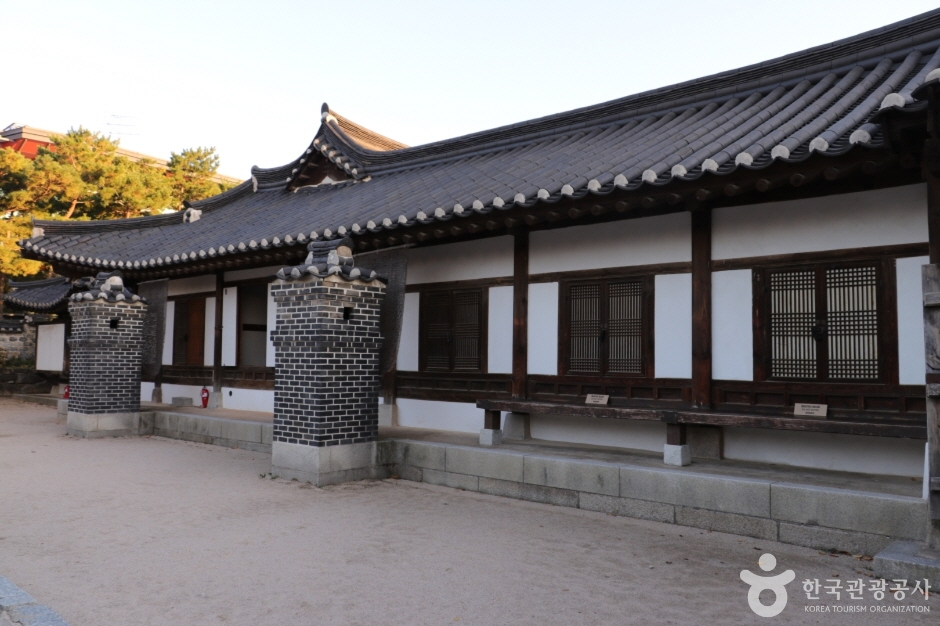
관훈동 민씨 가옥 (구 부마도위박영효가옥)
Info only · no booking hereAbout
The Min family house, located at 30-1 Gwanhun-dong, was the residence of Min Yeong-hwi (민영휘), a late-Joseon politician listed in the pro-Japanese biographical dictionary, and his family. Min Yeong-hwi was a bureaucrat who served as a minister (panso) and bank president of Hanil Bank during the Japanese colonial period, amassing great wealth. In 1895, he moved from Anguk-dong to Gyo-dong, purchasing land in the Gwanhun-dong area to house his family. As of 1936, the property comprised a total of six buildings, including wooden-tiled houses and a two-story Western-style building, but in 1976, part of the house was lost, leaving only two wooden-tiled structures—a portion of the main building (anchae) and the gate quarters (mungangchae). In 1977, it was designated as a Seoul Metropolitan Folk Material. Min Yeong-hwi, his legal wife Daebang Mama of the Pyeongsan Shin clan, and their adopted eldest son Min Hyeong-sik lived in Gyeongun-dong, while his concubine Haeju Mama An Yu-pung and her son Min Dae-sik lived in Gwanhun-dong, with their descendants also residing together across the Gyeongun-dong and Gwanhun-dong area. Lot 30 Gwanhun-dong remained in the possession of Min Yeong-hwi's descendants until the 1970s, and after going through auction and sale, Gyeongin Art Museum acquired ownership in 1986. During the museum's ownership, from 1995 to 1998, a portion of the main building and the gate quarters were relocated and restored to Namsangol Hanok Village, where they remain today.
- Hours
- - Summer season (April–October) 09:00–21:00 - Winter season (November–March) 09:00–20:00- 하절기(4월~10월) 09:00~21:00 - 동절기(11월~3월) 09:00~20:00
- Closed
- Every Monday (however, if Monday is a public holiday, normal operations apply)매주 월요일 (단, 월요일이 공휴일인 경우 정상 운영)
- Parking
- possible가능
- Contact
- 02-6358-5533
Machine-translated from Korean. It may contain errors — the Korean original is kept next to short entries.