광화문
Info onlyAbout
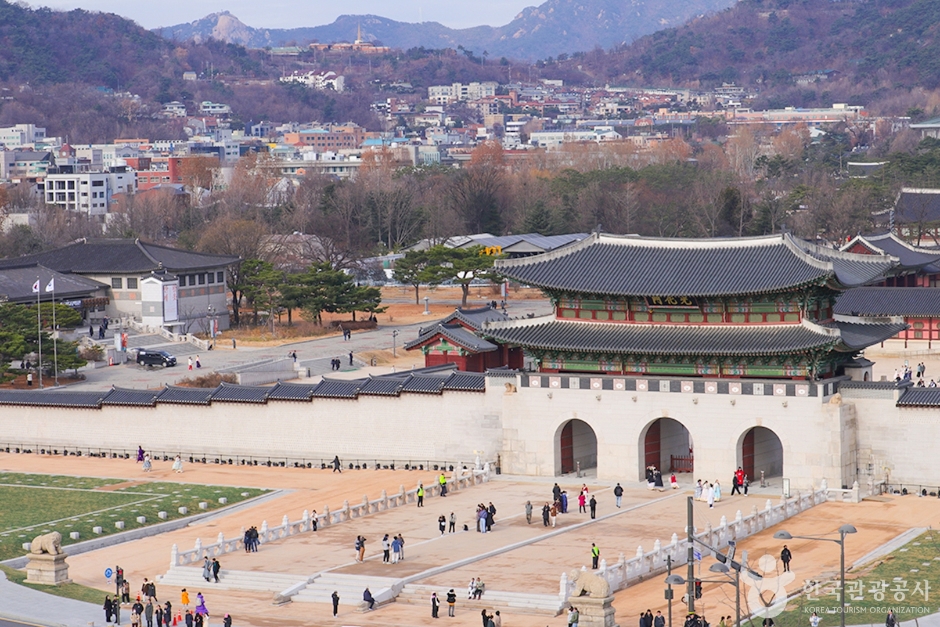
Gwanghwamun was the main gate of Gyeongbokgung Palace, serving as the gate through which the king entered and exited. However, because it was the main gate of Gyeongbokgung, the legal palace (beopgung) of the Joseon Dynasty, it was far more grand and splendid in scale and formality compared to the main gates of other palaces. Additionally, Gwanghwamun had Dongshipjagak (East Pavilion) and Seoshipjagak (West Pavilion) at the eastern and western ends of its walls, respectively, making it the only gate among the five grand palaces of Joseon to be equipped with a full palace-gate layout. Gwanghwamun consists of three arched gates (honge) in the stone platform base that supports the two-story gate pavilion; the king passed through the central arch, while the crown prince and officials used the left and right arches. A bell was hung in the gate pavilion to announce the time. The fact that Gyeongbokgung was the legal palace of the Joseon Dynasty is also evident in the form of its gates, including Gwanghwamun. While the gates of other palaces were built on low platforms, Gyeongbokgung's gates were constructed on tall stone bases with arched entrances in the center, resembling fortress gates. Among them, Gwanghwamun features three arched gates, displaying the highest level of formality. This clearly reveals that Gwanghwamun was the main gate of the legal palace. Originally, Gwanghwamun was moved to the north of Geonchunmun, the eastern gate of the palace grounds, during the construction of the Japanese Government-General Building, but during the Korean War it was bombed, destroying the gate pavilion and leaving the stone base riddled with bullet marks. Amid this, Gwanghwamun was rebuilt in its current form only in 1968 under the Park Chung-hee administration. The destroyed gate pavilion was reconstructed, and Gwanghwamun was relocated to its present site. However, the newly rebuilt Gwanghwamun was constructed of reinforced concrete, and at the time of reconstruction, its axis was aligned not with the central axis of Gyeongbokgung but with that of the former Japanese Government-General Building, then used as the Central Government Hall, resulting in a deviation of about 3.5 degrees from the original axis. Moreover, it was set back approximately 14.5 meters from its original location to stand where it is today. To restore Gwanghwamun, which had lost its original form, demolition work began in 2006, and after three years and eight months of restoration, it was completed on August 15, 2010. A massive granite base was built, with a two-story gate pavilion placed atop it, offering excellent views from afar while conveying the dignity of a main palace gate. The three arched entrances in the base showcase the majesty of Gyeongbokgung as the primary palace of Joseon. On the stone base, a low wall was built using fired clay bricks called "jeondol," and the Eight Trigrams (palgwae) patterns decorating it well reflect the characteristics of Joseon-era palace architecture.